The three building blocks of a forecast

ccPlanning academy · forecasting
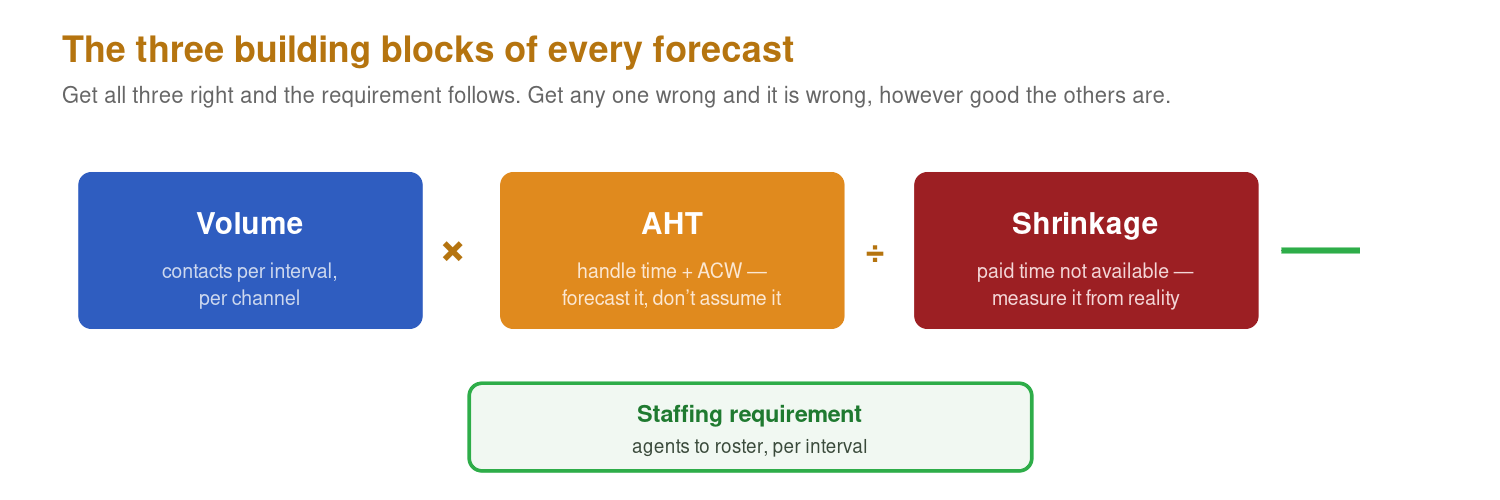
The three building blocks of a forecast
Five minutes on the foundation every contact-centre forecast rests on.
How they combine
Volume × AHT, grossed up for shrinkage
Slides done? Here’s the same idea in a bit more depth — the part worth keeping.
In depth: why three blocks, and why the weakest one wins
Almost every forecasting conversation is really a conversation about volume. It’s the number that lands in the inbox, the line on the chart everyone points at, the thing the forecast is judged on when it misses. So it’s where the effort goes — the seasonality, the day-of-week shape, the clever model. None of that is wrong. But staffing isn’t driven by how many contacts arrive; it’s driven by how much work arrives and how much of your paid time is free to do it. Volume is only the first of three numbers that decide that, and it’s the one least likely to sink you, precisely because it gets the attention.
Volume tells you how many; AHT turns that into work
A thousand contacts could be twenty hours of work or two hundred, depending entirely on how long each one takes. That’s average handle time, and it’s the multiplier that converts a contact count into a workload. The trap is that AHT looks stable — one tidy number you can carry forward — so people freeze it and move on. In reality it drifts with the mix of contact types, creeps up as products and regulation get more complex, and shifts the moment a chatbot or self-service starts deflecting the simple stuff, because what’s left for your agents is the hard residual. Treat AHT as something to be forecast in its own right, not a constant.
Shrinkage is where small errors do the most damage
Once you know the workload, you gross it up to cover everything that takes an agent away from contacts — leave, training, breaks, sickness, meetings, coaching, the lot. That’s shrinkage, and it sits at the final step of the calculation, which is exactly what makes it dangerous. An error here doesn’t wash out against anything; it scales the whole requirement. A shrinkage assumption that’s eight points too low doesn’t make you 8% short — it can leave you double figures short of staff, every single week, with a volume forecast that looks immaculate.
The principle to remember: the staffing requirement is only ever as good as the weakest of the three blocks. Forecasting volume to two decimal places while carrying one inherited shrinkage figure all year is doing the easy third of the job brilliantly and the hard two-thirds badly. Spread the rigour across all three.
Quick quiz
Five questions. Pick an answer to each, then check your score.
1. How many building blocks does every forecast rest on?
Three: volume, AHT, and shrinkage. Miss any one and the staffing requirement is wrong.
2. Which block is most often treated as a fixed assumption when it should be forecast?
AHT. It drifts with channel mix, complexity, and self-service deflection — so it deserves its own forecast, not a frozen average.
3. Why is a shrinkage error so damaging?
Shrinkage grosses up the requirement at the final step — model it optimistically and you under-staff all year.
4. You nail the volume forecast but fudge AHT and shrinkage. Your staffing will be…
Wrong. The requirement is only as good as the weakest of the three blocks.
5. What’s the right discipline?
Forecast all three. The craft is in the fundamentals, not the sophistication of the method.
Go deeper: read The Forecasting Masterclass or try the volume forecaster and shrinkage calculator.